
Haryana's affordable housing scheme sells flats of 28 to 60 sq m of carpet area at a rate the state caps, and gives them out by a draw of lots. The rules are in the Affordable Housing Policy 2013, notified on 19 August 2013, and in the papers that have changed it since. We read the policy and ten of those papers on DTCP Haryana's website, and DTCP's e-draw portal, where people apply. This guide answers the questions people ask most, from those papers. A project's own advertisement and allotment letter set out its terms, so read those too.
Who can apply?
Any person can apply. Since July 2018 the first preference goes to families identified under the Pradhan Mantri Awas Yojana (PMAY) by Haryana's Urban Local Bodies Department: first those of the same town, then those of the rest of the state. Next come applicants who, with their spouse and dependent children, own no flat or plot in a HUDA sector or a licensed colony in any urban area of Haryana, in Chandigarh or in Delhi. Then everyone else.
You may make only one application in a project, though you may apply in more than one project. If you win in more than one, you keep only one flat. Applicants give an affidavit saying this. The developer may also allot up to 5% of the flats to its own employees, associates, friends or relatives, at the same rate, if their names are given to the draw committee.
What is e-draw TCP Haryana?
It is the online portal of Haryana's Department of Town and Country Planning (DTCP, often called TCP Haryana) for the draw of flats under the affordable housing policy. Its address is edraw.tcpharyana.gov.in, which opens the page "tcp-dms/home"; DTCP's own website links to it as the place to apply online for the e-draw. Since a change of July 2019, developers take applications online through the Senior Town Planner, so this portal is where you register, log in, apply, pay, and see the result. It is the official website for the scheme; a broker's website or a "booking" form on social media is not.
How to apply online, step by step
Applications are made on DTCP Haryana's e-draw portal, edraw.tcpharyana.gov.in. The screens below are from the portal as it was on 20 November 2026. We did not register or apply, so the steps after the login are not shown here.
1. Find a project that is open. The portal opens on the "LIVE" tab, which lists the projects taking applications, with the dates for applying and for paying. The "CLOSED" tab has past draws. "Advance Search" lets you pick a district, a town or a developer. On 20 November 2026 the two open projects were in Faridabad and Sonipat; none was in Gurugram.
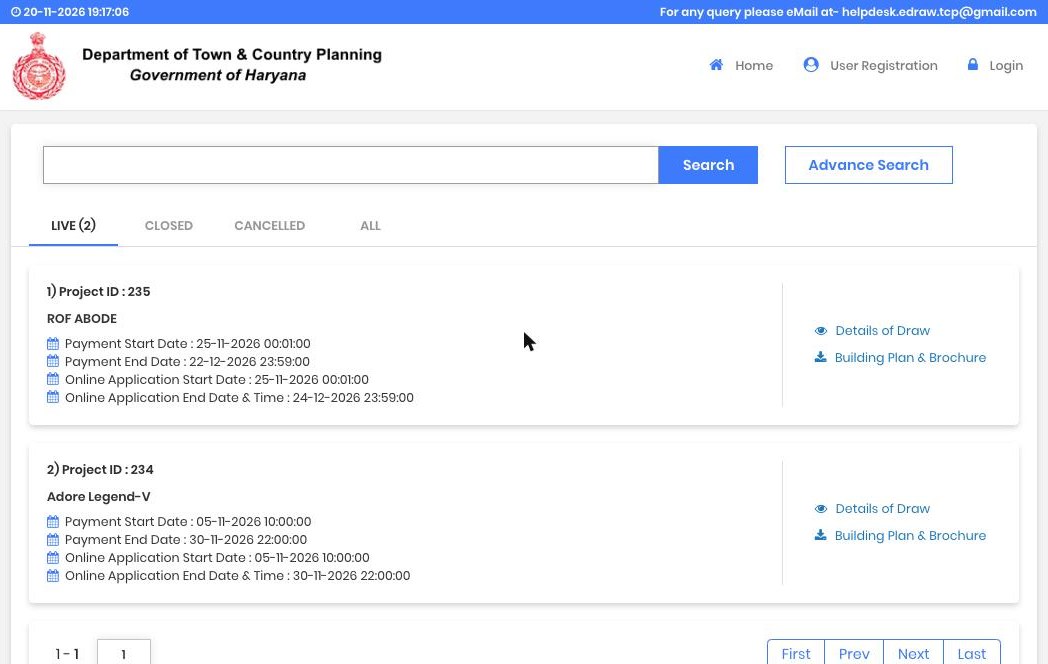
2. Read the project's details. "Details of Draw" shows the district and town, the licence and RERA numbers, the dates for applying and paying, the proposed date of the draw, and a table of the flats: the carpet area, the rate per sq ft, the balcony area and rate, the deposit and the registration fee. "Building Plan & Brochure" has the plans. The page also says if a refund applies. If you apply in the PMAY category, the portal says you must upload your PMAY certificate, or the application can be rejected.
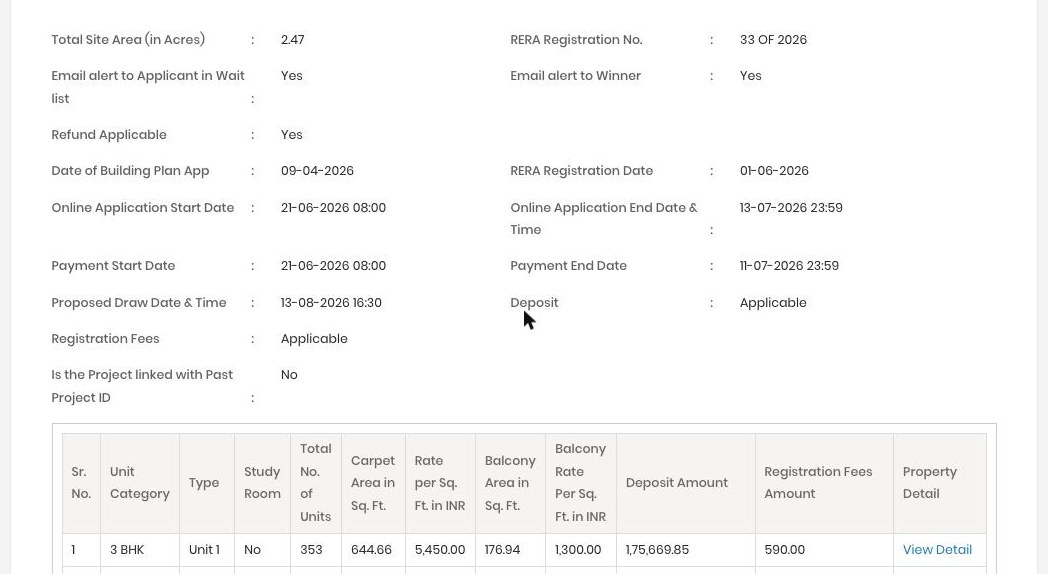
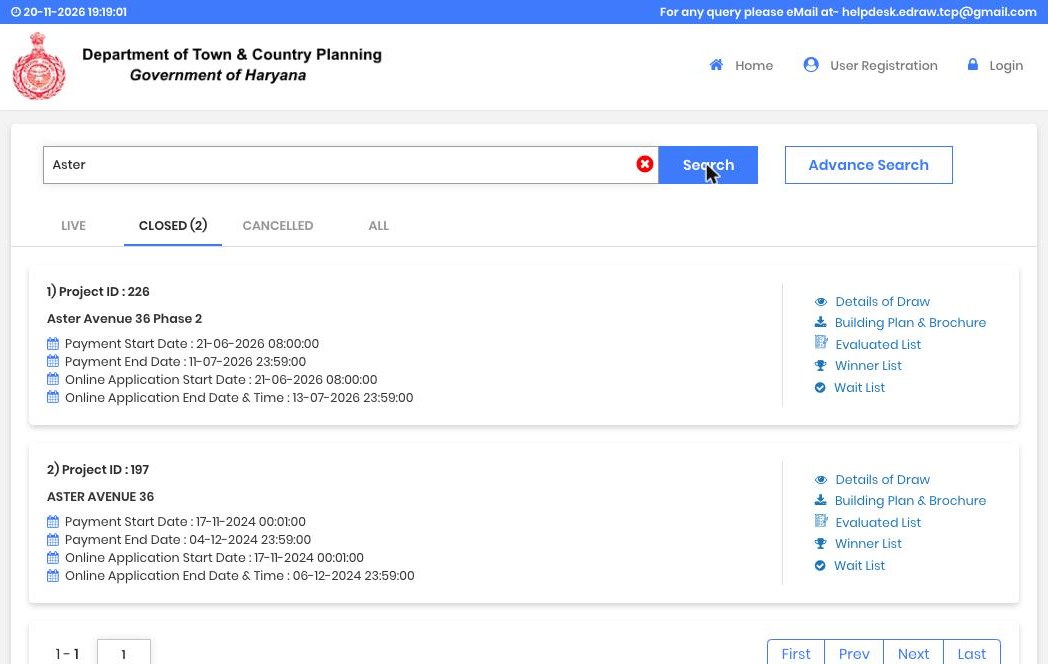
For Aster Avenue 36 Phase 2 in Sohna, applications ran from 21 June to 13 July 2026, and the draw was set for 13 August 2026. A flat of 644.66 sq ft at ₹5,450 per sq ft had a deposit of ₹1,75,669.85, which is 5% of its carpet-area cost, and a registration fee of ₹590.
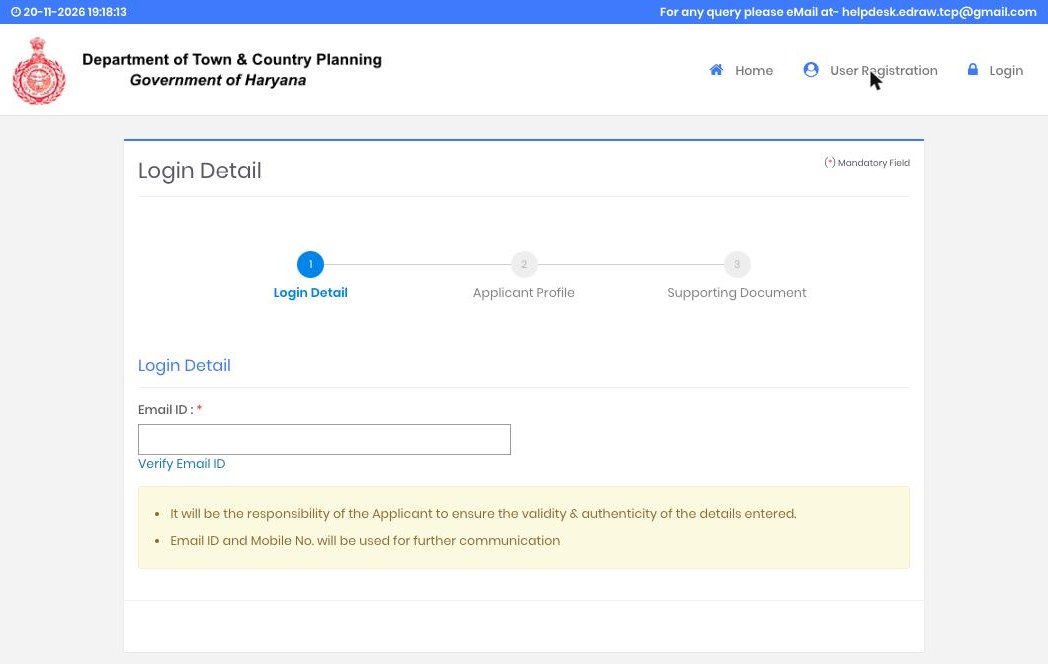
3. Register. "User Registration" has three steps: login details, your profile, and supporting documents. The first step asks for your email address, which you verify, and your mobile number, a password and a captcha. The portal uses this email and mobile number to reach you.
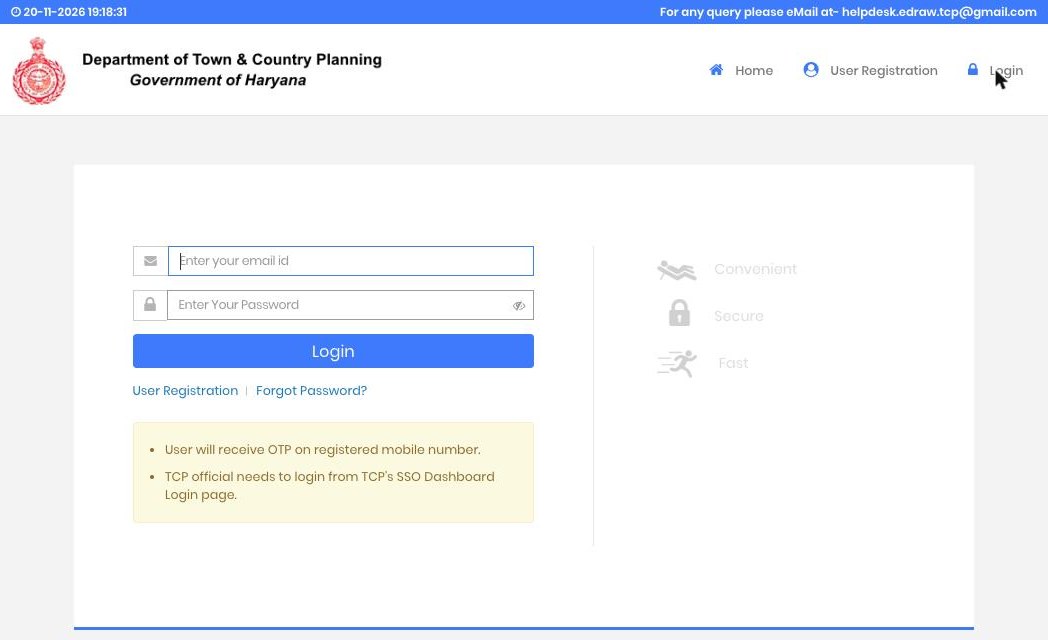
4. Log in and apply. You log in with your email and password, and an OTP comes to your registered mobile number. You then apply for the project and pay the deposit and the registration fee within the payment dates shown.
5. Check the result. After the draw, the project moves to the "CLOSED" tab with three lists: the Evaluated List, the Winner List and the Wait List. The portal can also email winners and those on the waiting list.
What are the Evaluated List, Winner List and Wait List?
They are the three PDF files a closed project shows on the portal, and together they are the draw result. The Evaluated List names the applications that were checked (evaluated) for the draw. The Winner List names those who got a flat in the draw, and the Wait List those on the waiting list, in order. To find your result, open the project in the "CLOSED" tab, open the lists and look for your name or your application's details. Winners and those on the waiting list can also get an email from the portal.
Which projects are open now, and what is the last date?
The portal's "LIVE" tab lists every project taking applications, each with its own last date for applying and for paying. There is no single last date for the scheme: each project has its own window, of about three weeks for Aster Avenue 36 Phase 2. On 20 November 2026 the open projects were in Faridabad and Sonipat, and none in Gurugram.
Are the flats 1, 2 or 3 BHK?
The policy sets the size, not the number of rooms: a carpet area of 28 to 60 sq m, that is about 301 to 646 sq ft. Each project's details on the portal show its types. Aster Avenue 36 Phase 2 lists its flats of 644.66 and 645.09 sq ft as 3 BHK; the draft agreement for sale of Nakshatra by Nowara describes a flat as 2 BHK with two toilets.
What does a flat cost?
The policy caps the price per sq ft of carpet area, and the cap depends on the town. Since the change of 8 April 2026 it is ₹5,575 for Gurugram, ₹5,450 for Faridabad and Sohna, ₹5,050 for other high and medium potential towns and ₹4,250 for low potential towns. Balconies cost ₹1,300 per sq ft, for up to 100 sq ft, and no more than ₹1.3 lakh a flat. For Gurugram the cap was ₹4,000 in 2013, ₹4,200 from November 2021 and ₹5,000 from July 2023. The new rates apply to projects that had not yet made their allotments.
Parking has changed too. The 2013 policy gave each flat a two-wheeler space and no car space. From January 2021 every flat had half a car space free, and the developer could sell a car space for up to 5% of the flat's cost. Since April 2026 each flat must get one car space, charged at 10% of the flat's cost.
How much do I pay with the application?
5% of the flat's cost, as the deposit, plus the registration fee the portal shows. If the developer holds your deposit for more than 90 days after applications close, before it allots you a flat or returns the money, it owes you interest at 10% a year on it.
How does the draw work?
Since July 2019 the developer invites applications through the Senior Town Planner, and they are taken online. The project is advertised at least three times in three newspapers, one English national daily and two Hindi papers, with at least three months between two advertisements. The first draw is held within four months of the first advertisement. After three such attempts, the developer may allot the flats left on a first-come-first-served basis, at the same rates.
The applications are checked with the District Town Planner within three months, and ineligible applicants get their deposit back within a month of the check, without interest. The draw is held before a committee: the Deputy Commissioner or a representative, the Senior Town Planner, the District Town Planner and the developer's representative. An application with a small mistake, like a missing entry or an unclear copy, can still go into the draw. If it wins, the applicant has 15 days from the published list to put it right, or loses the flat.
What is the waiting list?
A waiting list of up to 25% of the flats is drawn at the same time. A flat goes to the next person on it when a winner surrenders, fails to put the application right in 15 days or has the allotment cancelled. The list is kept for two years. You can leave it whenever you like and get your deposit back within 30 days, with no deduction. After two years the money is returned without interest.
I was not picked. When do I get my money back?
Within 15 days of the draw, in full. If the developer held the money for more than 90 days after applications closed, the 10% a year interest also applies.
Two other cases bring a refund. When the rates went up in April 2026, applicants who did not want to take part at the new rate could take their money back without deduction. And if a draw is cancelled, applicants can withdraw. A public notice of the Senior Town Planner, Gurugram, dated 1 May 2025, says the e-draw of 27 January 2025 for 708 flats of Aster Avenue 36 in Sohna (the first phase) was cancelled after the department noticed an anomaly, and a fresh draw would be held among the same 51,586 shortlisted applications. Those who chose "withdraw" on the portal before it were to be refunded. That is about 73 applications for each flat.
The portal has no public page to check a refund. If yours is late, write to the developer and the District Town Planner, and keep a copy. A complaint about a registered project can be made to HRERA.
I was picked. What do I pay, and when?
Another 20% of the cost when the flat is allotted. Since November 2021, the other 75% is paid by stages of construction, as set out in the builder-buyer agreement. Before that it was six instalments over three years. If the developer does not get the environmental clearance within a year of the draw, you may ask for your money back with 12% interest. A late payment carries the interest set in Rule 15 of the Haryana RERA Rules, 2017. If you still do not pay after a reminder and a newspaper notice, the allotment can be cancelled and ₹25,000 deducted from what you paid.
A July 2019 change made those allotted a flat in a later draw pay on the same schedule as the first draw's winners, so several payments can fall due at once. In 2024 the Haryana Real Estate Appellate Tribunal held that it does not apply to agreements signed before the change, The Tribune reported.
How do I withdraw an application?
Through the portal, where a project offers it. When the department cancelled the Aster Avenue 36 draw of January 2025, its notice told applicants who did not want to take part in the fresh draw to choose "withdraw" on the portal before the new draw, and said they would be refunded. When the rates rose in April 2026, applicants who did not want to go on at the new rate were to get their money back without deduction, after a public notice from the developer. If you are on the waiting list, you may leave it at any time and get your deposit back within 30 days.
Can I surrender the flat?
Yes. The developer may deduct ₹25,000 and must return the rest. The draft agreement for sale one Gurugram project filed with HRERA says the balance is returned within 90 days.
Can I sell the flat later?
The 2013 policy bars a sale for one year after possession. Selling earlier carries a penalty of 200% of the selling price, and a sale through a general power of attorney counts as a sale. A memo of 26 September 2018 says clause 7(iii), the clause number of that bar, is to be treated as deleted from 22 July 2015, but the reason it gives fits another clause, the one on when flats may be allotted. So it is not clear that the bar has gone. The draft agreement for sale that Nakshatra by Nowara filed with HRERA still carries the one-year bar. Read your own agreement, and ask the District Town Planner in writing before you sell within a year.
Can I rent the flat out?
The policy's bar is on selling or transferring the flat. It says nothing about letting it. Your agreement for sale may say more, so read it.
Is this the HUDA or the Housing Board scheme?
No. Affordable group housing flats are built and sold by private developers licensed by DTCP, under the 2013 policy. HUDA, now the Haryana Shehri Vikas Pradhikaran (HSVP), and the Housing Board Haryana have schemes of their own, applied for on their own websites. The EWS flats that builders set aside are a third scheme; see our guide to EWS flats in Gurgaon.
Is affordable housing a good buy?
That depends on you, but these facts matter. The price is capped by the state. The flats are small, of up to 60 sq m of carpet area. The draws are crowded: the first phase of Aster Avenue 36 had 51,586 applications for 708 flats, about 73 for each flat. You may keep only one flat under the scheme. And the flat may not be sold for a year after possession, if that bar still applies (see above). Nothing in the scheme promises a rise in value.
Whom do I contact?
For the portal, its helpdesk email is shown at the top of every page. For a project, the developer, whose name is on the project's details. For a complaint about the draw or a refund, the District Town Planner or the Senior Town Planner of the district. For a complaint about a registered project, HRERA.
What else should I keep in mind?
The developer has to finish the project within four years of the building plan approval or the environmental clearance, whichever is later. Since November 2021 its licence can be renewed beyond that. It maintains the colony free for five years after the occupation certificate, then hands it to the residents' association. The application form must list the fittings and finishes of the flat. Keep a copy of the form, the payment receipt and the advertisement. And never pay anyone who promises a flat outside the draw. For projects coming up, see our list of affordable housing projects registered with HRERA Gurugram.